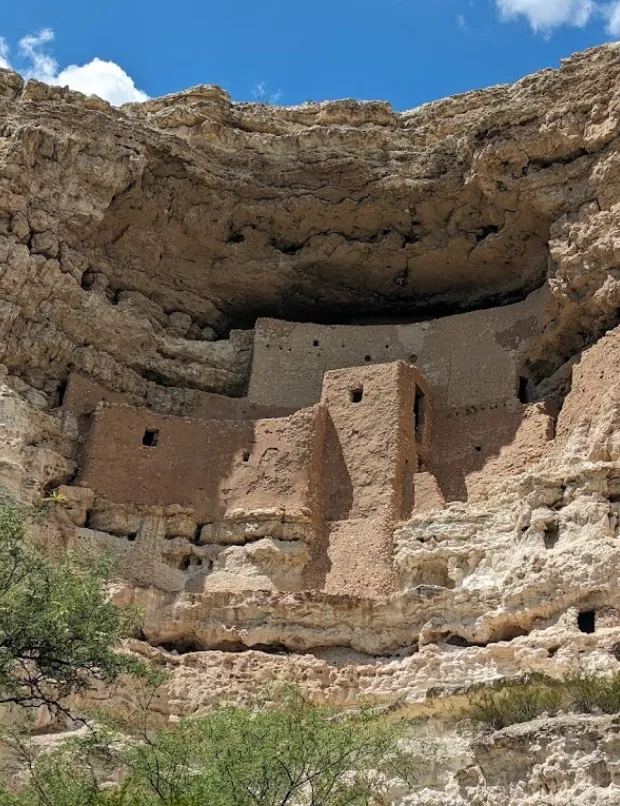
Tucked into a natural limestone alcove 70 feet above Beaver Creek in central Arizona's Verde Valley, Montezuma Castle is one of the most impressive archaeological sites in North America — and one of the most undervisited. A 5-story, 20-room structure built entirely by hand more than 700 years ago, it has survived intact to a remarkable degree. At just $10 per person to visit, it may be the best value for a history experience in the entire American Southwest.
Who Built It and When — The Sinagua People
Montezuma Castle has nothing to do with the Aztec emperor Montezuma — that name was given by Anglo-American settlers in the 1800s who incorrectly assumed the structure was connected to Mexican civilizations. The dwelling was actually built and inhabited by the Sinagua people, a pre-Columbian Native American culture that flourished in the Verde Valley region of Arizona from roughly 900 to 1425 CE.
The Sinagua (a name derived from the Spanish for "without water," referring to the dry country they also inhabited farther north) were skilled farmers, hunters, and traders who built sophisticated communities throughout central Arizona. The cliff dwelling at what we now call Montezuma Castle was constructed primarily between 1100 and 1350 CE, using limestone blocks, mud mortar, and wooden beams cut from nearby trees. It was essentially an ancient apartment complex — a five-story, 20-room structure that housed approximately 35–50 people at its peak.
The Sinagua abandoned the Verde Valley around 1425 CE, for reasons that remain debated by archaeologists — drought, resource depletion, conflict, and cultural shifts all likely played roles. They left behind one of the most complete and structurally intact cliff dwellings ever found in North America.
- Construction period: approximately 1100–1350 CE
- 5 stories, 20 rooms, approximately 4,000 square feet of living space
- Housed ~35–50 people during peak occupation
- Built by the Sinagua people of the Verde Valley
- Abandoned around 1425 CE
Entry Fee, Hours, and What to Expect
Admission to Montezuma Castle National Monument is $10 per person, with children under 16 admitted free. The America the Beautiful Annual Pass is accepted and covers entry for the pass holder and all passengers in a non-commercial vehicle — making it an excellent deal if you're visiting multiple national parks and monuments on your Arizona trip.
The monument is open daily, typically from 8 AM to 5 PM (hours may vary seasonally — check the National Park Service website for current hours before visiting). There are no advance reservations required; just show up and pay at the entrance station.
One important thing to know: you cannot enter the cliff dwelling itself. Access to the interior rooms has been closed to the public since 1951 to protect the fragile structure. However, the view from the paved trail directly below is excellent — you're close enough to see the construction details, the wooden ceiling beams, and even the soot marks left by ancient cooking fires on the interior walls. Many visitors find the view-from-below experience more impactful than climbing inside would be; the dwelling looming overhead in its limestone alcove is a genuinely striking sight.
Montezuma Well — The Free Bonus Stop 11 Miles Away
About 11 miles north of Montezuma Castle is a separate detached unit of the same national monument that almost nobody knows about: Montezuma Well. And it's completely free to visit.
Montezuma Well is a natural limestone sinkhole about 368 feet across and 55 feet deep, fed by a constant flow of 1.5 million gallons of water per day from underground springs. The Sinagua people recognized its value and engineered an ancient irrigation system — ditches and canals carved from the rock — to divert the spring water to their agricultural fields below. Parts of this irrigation system are still visible today and still flowing after nearly a thousand years.
The Well also contains a unique ecosystem: its water has such high carbon dioxide and arsenic concentrations that no fish can survive, but five species of aquatic invertebrates found nowhere else on earth have evolved to thrive in these unusual conditions. Cliff swallow colonies nest in the limestone walls. Ducks paddle on the surface. It's a bizarre and beautiful little ecosystem that scientists study today.
The short loop trail at Montezuma Well visits the top of the sinkhole overlook, descends to the water's edge, passes by ancient cliff dwellings (different from Montezuma Castle — smaller and less elaborate), and follows the original Sinagua irrigation canal. Allow about 45–60 minutes. This stop is absolutely worth the 20-minute detour.
Nearby Attractions — Building a Full Day Trip
Montezuma Castle sits at the center of a cluster of excellent day trip destinations in the Verde Valley. With smart planning, you can pack an extraordinary amount of Arizona's history and scenery into a single day.
- Sedona (25 miles southwest): Arizona's famous red rock country — Cathedral Rock, Bell Rock, Airport Mesa, and dozens of hiking trails amid striking red sandstone formations. Sedona itself is pricey for dining and lodging, but the outdoors is free. Budget 2–3 hours if visiting.
- Jerome (20 miles west): A former copper mining boomtown turned artist colony and ghost town, perched dramatically on the side of Mingus Mountain. Excellent restaurants, quirky shops, and genuinely interesting history. Parking is $2/hour or free on side streets below town.
- Tuzigoot National Monument (15 miles northwest): Another Sinagua ruin — a hilltop pueblo overlooking the Verde River. Entry is $10 or free with the America the Beautiful Pass. Less famous than Montezuma Castle but fascinating for its hilltop setting and 110+ rooms.
- Camp Verde (7 miles south): The nearest town to Montezuma Castle, with gas stations, grocery stores, and affordable fast food options for fueling up between stops.
Base your stay in either Sedona (beautiful but expensive) or Cottonwood/Camp Verde (more affordable, very functional). From Phoenix, the drive to Montezuma Castle is about 90 minutes north on I-17 — easily a day trip from the city.
Best Time to Visit and Photography Tips
Montezuma Castle is open year-round and worth visiting in any season, but timing matters for comfort and photography:
- Spring (March–May): Ideal. Temperatures are mild (60–80°F), wildflowers bloom along the creek, and morning light illuminates the cliff face beautifully. This is the best time overall.
- Fall (September–November): Second-best window. Crowds thin after Labor Day, cottonwood trees along Beaver Creek turn golden in October, and temperatures are perfect.
- Summer (June–August): Very hot (95–105°F). The dwelling itself is shaded, but the parking area and trail can be brutal midday. Visit early (open at 8 AM) to beat both heat and crowds.
- Winter (December–February): Quiet and peaceful, with possible snow in surrounding mountains. The dwelling looks striking with frost on the canyon walls. Dress in layers.