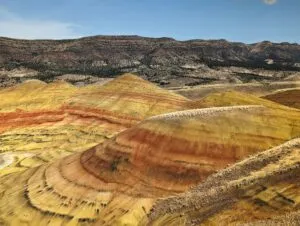
The Painted Hills look like they were made by an artist who had too much pigment and a very large canvas. Rolling domes of earth striped in brick red, burnished gold, charcoal black, and tan sprawl across the high desert of central Oregon, and none of it is painted at all — every color comes from millions of years of volcanic ash layering, weathering, and mineral deposits. They are one of the Seven Wonders of Oregon, a unit of a national monument, and completely, 100% free to visit.
What Creates the Colors — The Geology Explained
The Painted Hills are part of the John Day Fossil Beds National Monument, a collection of three separate units spread across a wide area of central Oregon. The Painted Hills unit preserves a landscape that formed over roughly 35 million years during a period of intense volcanic activity in the Pacific Northwest.
The colors you see correspond to different soil and mineral compositions in each layer:
- Red and orange: Laterite soil formed from ancient floodplain deposits that were exposed to air and oxidized — essentially rust coloring from iron compounds
- Black: Layers rich in manganese oxides, often marking ancient swamp environments
- Gold and yellow: Altered volcanic ash beds rich in iron and silica compounds
- Tan and pale yellow: Claystones and siltstones from drier ancient environments
Each distinct stripe represents a different chapter in the region's geological history — a visual timeline 35 million years long, exposed by erosion and visible from the trail. The hills themselves are surprisingly fragile; the colorful soils are water-soluble and easily damaged by foot traffic, which is why all trails stay on established paths and visitors must not walk on the hills themselves.
The Trails — Which Ones to Hike
The Painted Hills unit has five short trails, all of them free and open year-round during daylight hours. None of them are particularly strenuous, but together they give you the full experience of the landscape from multiple perspectives.
Painted Hills Overlook Trail (0.5 miles, easy)
This is the classic viewpoint — a short paved path that climbs a gentle hill to a ridge with a panoramic view over the entire Painted Hills basin. This is the shot you've seen in every article about this place. Most visitors spend 15–20 minutes here. Best at sunrise and sunset when the light angles make the colors glow.
Carroll Rim Trail (1.6 miles round trip, moderate)
This trail climbs to the highest point in the area, giving you a bird's-eye view looking down over the Painted Hills and out across the surrounding high desert valleys. The elevation gain is modest but the views at the top are significantly more expansive than from the overlook. A must-do if you have the time — allow 45–60 minutes.
Painted Cove Trail (0.25 miles, easy)
This short boardwalk loop takes you right into the red hills — as close as you can legally get to touching them. The red soil textures and patterns are extraordinary up close. This is the trail for macro photography of the soil details. Allow 15–20 minutes.
Leaf Hill Trail and Fossil Trail
Two additional short trails focus more on the paleontological history of the area — the fossil beds contain over 100 species of fossilized plant and animal remains from the Eocene epoch. Interpretive signs explain what was found in the surrounding hillsides.
Best Time to Visit for Color and Photography
The Painted Hills look different every season, every time of day, and even every cloud cover condition — which is part of their appeal for photographers who return repeatedly.
- May and June: The best overall time. Wildflowers bloom in the surrounding area, temperatures are mild (50–75°F), and the spring light is soft and directional. This is peak season but the hills are large enough that it never feels overly crowded.
- September and October: The second-best window. Summer heat has passed, fall light is golden, and crowds thin significantly after Labor Day.
- Sunrise and sunset: The light angle at low sun illuminates the reds and golds most intensely. Midday harsh sun flattens the colors considerably.
- Overcast days: Counterintuitively, soft overcast light can be excellent for photography — it eliminates harsh shadows and allows the subtle color gradations to show clearly. Don't skip the Painted Hills just because it's cloudy.
- After rain: Wet soil makes the colors significantly more saturated and vibrant. If rain has fallen in the past day or two, the hills will be at their most colorful.
- Summer (July–August): Hot (90°F+), dry, and busiest. Still beautiful, but visit early morning to beat heat and crowds.
Nearest Town, Base Camp Options, and Getting There
The Painted Hills are located about 9 miles west of Mitchell, Oregon — a tiny town of fewer than 200 people with a gas station, a small motel, and basic provisions. For anything beyond the basics, you'll need to plan ahead or drive further.
- Mitchell, OR (9 miles east): Small motel options and a restaurant — basic but functional for an overnight stay. The Painted Hills B&B in Mitchell is well-reviewed by visitors.
- Fossil, OR (50 miles north): A slightly larger small town with additional lodging options and the Sheep Rock unit of John Day Fossil Beds nearby.
- Bend, OR (~2 hours west): The best base for this trip if you prefer city amenities. Bend has an excellent food scene, dozens of hotels at all price points, and is easily one of Oregon's most enjoyable towns.
The nearest major airport is Redmond Municipal Airport (RDM), about 2 hours west of the Painted Hills — it serves several major hubs including Seattle, Portland, San Francisco, and Denver. From Portland, the drive is about 3.5 hours via US-26. A car is essential; there is no public transit to this area.
Combining with Other John Day Fossil Bed Units
If you're making the drive out to the Painted Hills, the other two units of John Day Fossil Beds National Monument are worth adding to your itinerary — all three are free.
- Sheep Rock Unit (~50 miles northeast): Home to the Thomas Condon Paleontology Center, a free museum with impressive fossil displays, and the Island in Time Trail through dramatic green and tan hills. This is where most of the scientific research happens.
- Clarno Unit (~75 miles northwest): The oldest and most remote unit, featuring fossilized palisades of ancient volcanic lahars and a fascinating trail explaining the ancient tropical forest environment that once existed here 44 million years ago.
A 3-day itinerary combining all three units, using Bend or Mitchell as your base, makes for one of the most interesting and completely free road trips in the Pacific Northwest.